
Disclosure: This page contains affiliate links. If you buy through them we may earn a commission, at no extra cost to you. We picked these models from published specifications and owner reviews; we have not lab-tested them.
Quick answer: A walking pad can help with weight loss because it adds hours of easy movement to days you would otherwise spend sitting, but only alongside a modest calorie deficit. Pick a pad with incline and real weight headroom: the TRAILVIBER X01 (12% auto incline, 450 lb), the Cardirun TM037 (handrail, 10% incline, 6.2 mph) or the FOUSAE X (40 in belt, 6.2 mph).
We compare 43 walking pads on their published specs in our walking pad comparison chart, and we flag it when a listing’s numbers don’t add up.
Slow walking adds up, but no machine causes weight loss by itself, and the calorie counter on the display is a rough guess. Here’s what a walking pad can realistically do, which settings matter, what to buy and a cautious four-week plan. If you’re starting a new exercise routine, check with your doctor first.
Quick picks
- Best overall for weight loss: TRAILVIBER X01. Push-button 12% incline and a 450 lb rating.
- Best with a handrail: Cardirun TM037. 10% manual incline and 6.2 mph with the rail up.
- Best for intervals: FOUSAE X. A flat pad that reaches 6.2 mph, with 12 programs.
- Best steep incline on a budget: LONTEK U20F-1. Up to 15% manual incline plus a handrail.
Does a walking pad help you lose weight?
Yes, a walking pad can help you lose weight, but only in the way any extra activity does: by raising the calories you burn so that, combined with what you eat, you end up in a modest deficit. It works best for people who sit most of the day, because it turns hours of sitting into hours of slow walking without needing extra time.
Walking at 2 mph isn’t intense; the value is volume. Two or three hours of desk walking covers four to six miles you wouldn’t otherwise have walked. Keep expectations realistic, though: those calories are easy to eat back, and weight loss is rarely linear.
How many calories does a walking pad burn?
Slow desk walking at 2 mph burns roughly 200 to 300 calories an hour depending on your weight, a brisk 4 mph walk roughly 360 to 520, and a real incline can push that higher still. These are estimates from standard activity tables, so use them to compare settings rather than to count calories precisely.
The figures below use published MET values for walking at three body weights. Your pad’s display is a cruder estimate again.
| Setting | 150 lb person | 180 lb person | 220 lb person |
|---|---|---|---|
| 2.0 mph, flat (typing pace) | about 200 cal/hr | about 240 cal/hr | about 290 cal/hr |
| 3.0 mph, flat | about 250 cal/hr | about 300 cal/hr | about 370 cal/hr |
| 4.0 mph, flat | about 360 cal/hr | about 430 cal/hr | about 520 cal/hr |
| 3.5 mph, 6–15% incline | about 570 cal/hr | about 690 cal/hr | about 840 cal/hr |
A real incline at moderate speed adds far more than extra speed, which makes incline the most useful feature on a pad bought for weight loss.
What speed and incline work best for weight loss on a walking pad?
For walking while you work, 1.5 to 2.5 mph is the range most people can sustain for hours while typing, and sustaining it matters more than any single setting. For dedicated sessions, 3 to 4 mph with a 5 to 10% incline burns far more per minute without needing to jog.
Most owners settle around 2 mph for typing and 2.5 to 3 mph for calls; our walking pad speed guide covers each task. Auto incline changes with a button mid-walk, while manual incline (fold-out legs or risers) is cheaper but set before you start. Our guide to walking pads with incline compares both.
What should you look for in a walking pad for weight loss?
Look for a weight rating at least 50 lb above your current weight, an incline you will actually use, and a belt long enough for your stride at the speeds you plan to walk. Apps and speakers matter far less than whether you’ll use the pad every day.
If you’re over about 250 lb, start with models rated 350 lb or more; our walking pads for heavy people guide lists them. About 35 inches of belt works for slow walking; 38 or more is better if you’re taller than about 5’10”. Our walking pad size calculator checks belt length and capacity against your height and weight.
The best walking pads for weight loss
1. Best overall for weight loss
TRAILVIBER X01
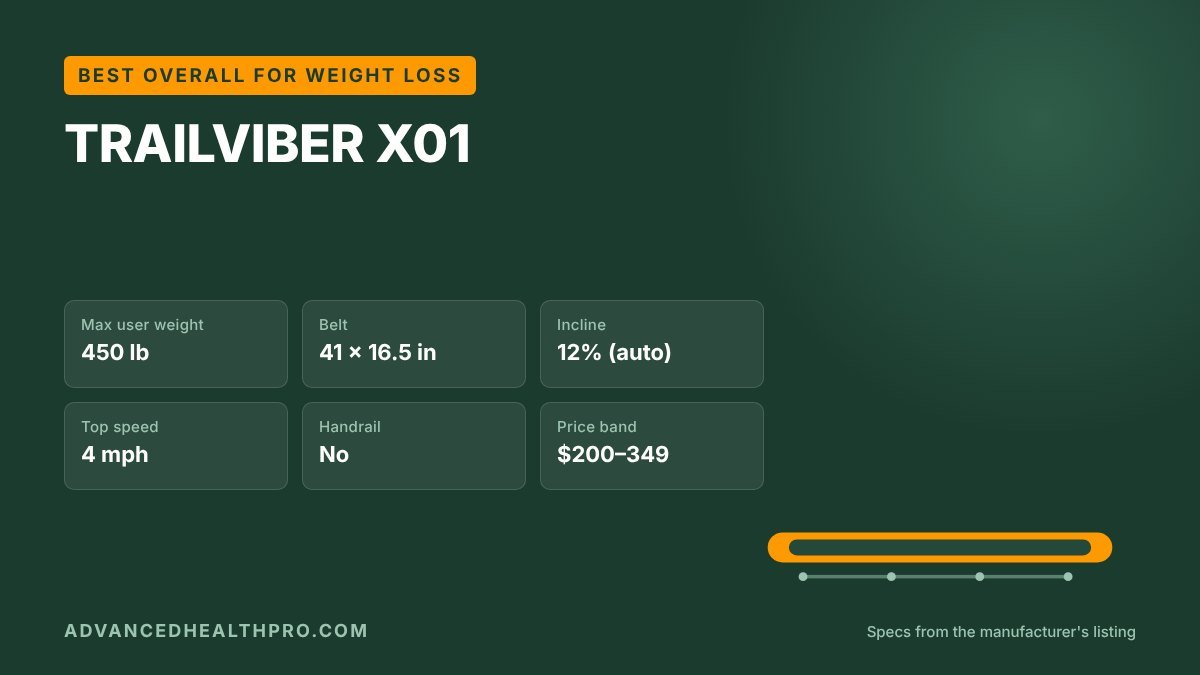
The X01 combines a motorized incline you can change mid-walk, up to 12% in nine steps, with a 450 lb rating that is tied for the highest in our chart. Its 41 × 16.5 in belt is among the longest we track outside the fold-in-half WalkingPad models. It tops out at 4 mph, but with the incline up you won’t miss the speed.
Why it stands out
- Push-button 0–12% incline
- 450 lb rating; 3-year warranty on the listing
Watch out for
- No handrail; walking only
- Some owners report app drop-outs and belts that needed centring
2. Best with a handrail
Cardirun TM037
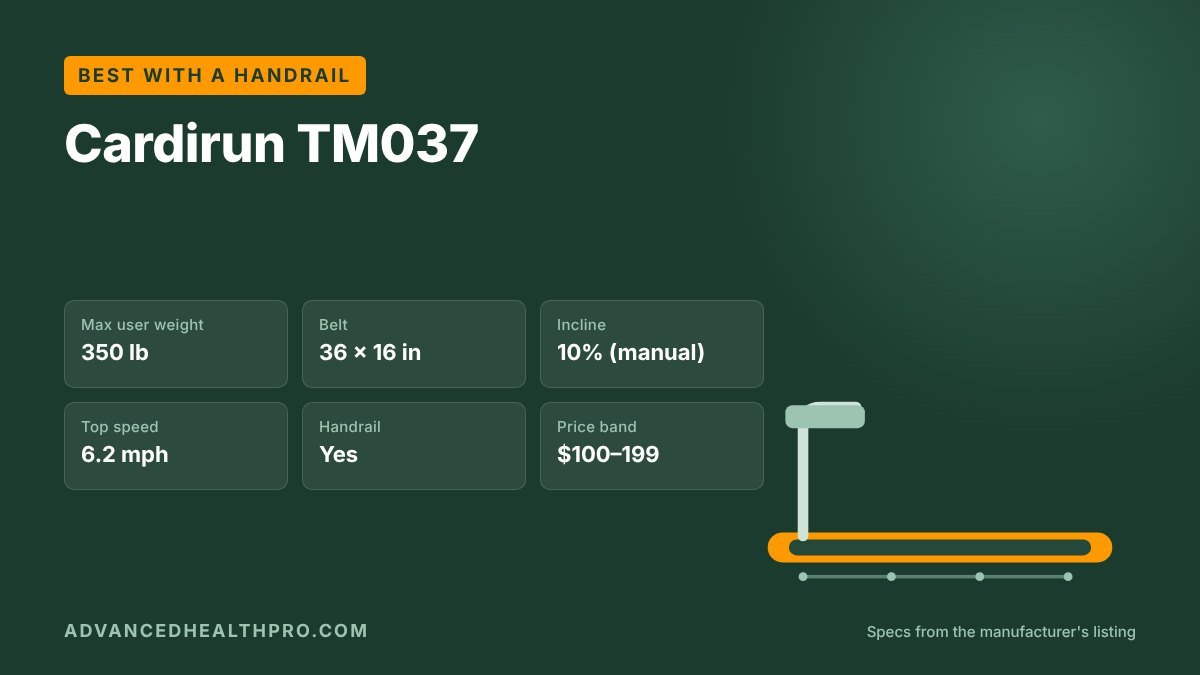
If you’re new to exercise or want something to hold while you get used to a moving belt, a handrail makes the first weeks easier. The TM037 folds its rail down to slide under a desk, then flips it up for a 6.2 mph session with a manual 10% incline. It’s also our best overall walking pad.
Why it stands out
- Handrail plus 10% incline and 6.2 mph
- 350 lb rating; 3-year warranty on the listing
Watch out for
- Incline is set by hand before you start
- Owners say the rail sits low for taller users
3. Best for intervals
FOUSAE X
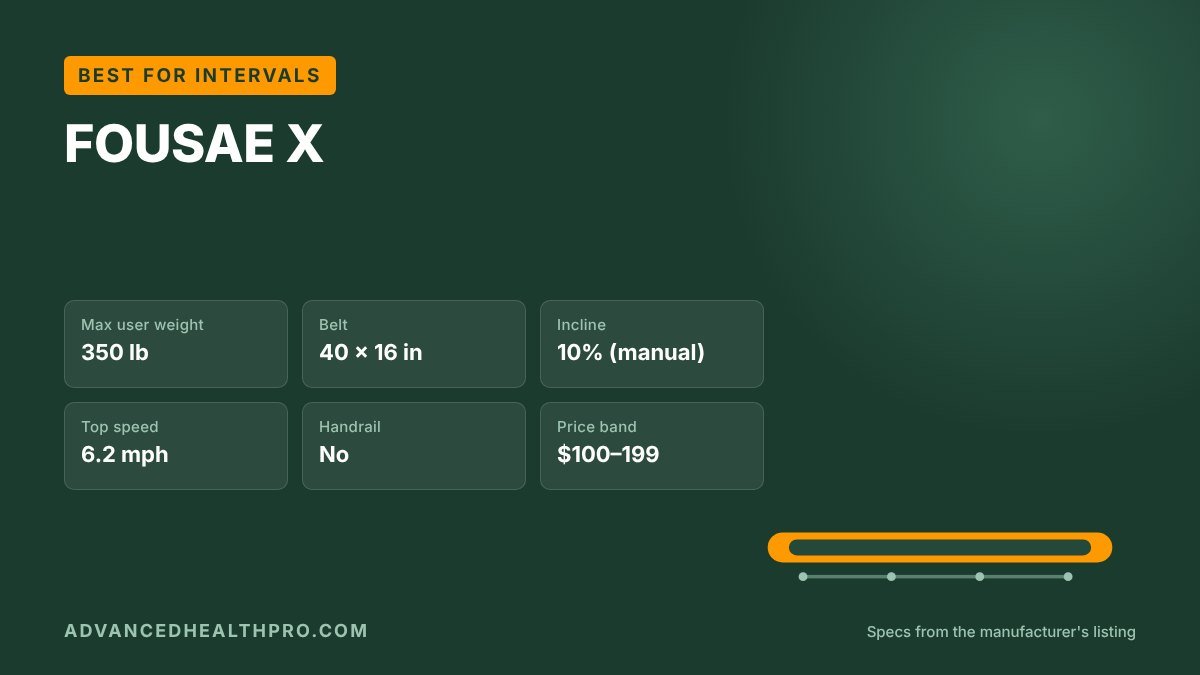
Once slow walking feels easy, alternating brisk and easy minutes burns more in the same time. The FOUSAE X is a flat pad under 5 in tall that still reaches 6.2 mph, with 12 built-in interval programs and a 40 × 16 in belt that gives a faster stride room.
Why it stands out
- 6.2 mph on a 40 × 16 in belt
- 12 interval programs; claimed under 40 dB
Watch out for
- No handrail, which matters at faster speeds
- No app; 1-year warranty on the listing
4. Best steep incline on a budget
LONTEK U20F-1
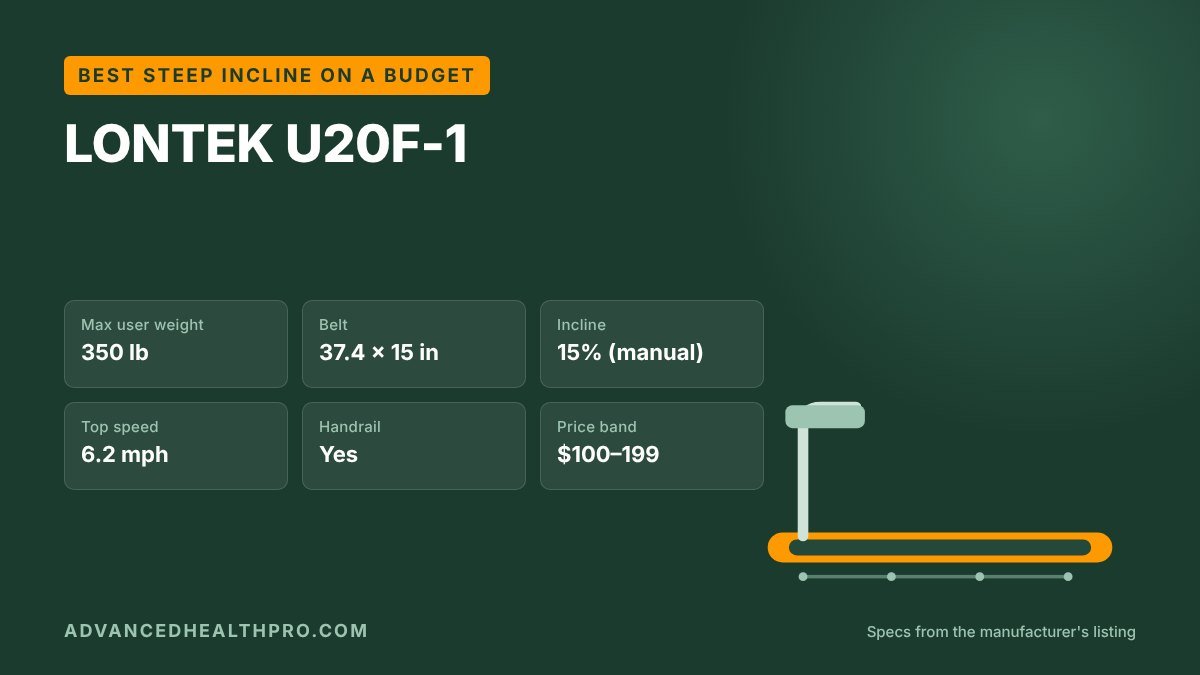
The U20F-1 offers flat, 10% with fold-out legs, or 15% with the included riser pads. Only one model in our chart lists a steeper incline, and this one adds a folding handrail and 6.2 mph top speed in a lower price band than most incline pads.
Why it stands out
- 15% incline, tied for second-steepest in our chart
- Handrail; 350 lb rating
Watch out for
- Incline can’t be changed while walking
- No app; 1-year warranty on the listing
Want to filter all 43 models by your weight, budget and incline? Use the full walking pad comparison table.
What does a realistic walking pad weight-loss plan look like?
A realistic plan starts with 20 to 30 minutes of slow walking a day and builds toward two hours of desk walking plus a few short incline sessions a week by the end of the first month. The goal of the first four weeks is to make the pad a habit, not to chase a number.
- Week 1: 20 to 30 minutes a day at 1.5 to 2 mph, flat. A pad raises you 4 to 6 inches, so set your desk higher.
- Week 2: two 30 to 45 minute blocks a day at 2 mph. If typing suffers, slow down rather than stop.
- Week 3: add two 15 minute sessions at 3 mph with a 5% or higher incline.
- Week 4: aim for two hours of desk walking a day and three incline sessions a week.
Pair the walking with a modest, sustainable change to what you eat. If you have a heart condition, joint problems or are pregnant, talk to your doctor first, and stop if you feel dizzy or in pain.
How we chose
We did not test these pads. We compared the published specs and owner reviews of the 43 walking pads in our comparison chart and shortlisted models with an incline, a 350 lb or higher rating and a belt of at least 36 inches. We confirmed each pick was still listed on Amazon on publication day; two otherwise suitable models were dropped because their listings had gone. Calorie figures come from published MET tables, not the pads’ displays.
From our shop
Walking Pad 30-Day Plan & Tracker
If you want a plan like the one above as a printable you can tick off day by day, our planner lays it out, plus a desk height worksheet, a speed guide for typing and calls, a 30-day plan in three levels, and daily and 100-mile trackers. US Letter and A4.
We make and sell this planner ourselves.
Frequently asked questions
How long should I walk on a walking pad to lose weight?
There is no fixed number, but the extra calories become meaningful once you reach one to two hours of slow walking a day. Start with 20 to 30 minutes and build up; consistency over weeks matters more than any single long session.
Is 2 mph on a walking pad enough to lose weight?
2 mph burns roughly 200 to 300 calories an hour depending on your weight, which is modest on its own. Over two or three hours a day it adds up, and it’s slow enough to sustain while working.
Is incline or speed better for burning calories on a walking pad?
At desk-friendly speeds, incline. Standard activity tables put 3.5 mph on a 6 to 15% grade at roughly double the burn of 3.5 mph on the flat, without the typing problems that come with speed.
Can I lose weight on a walking pad without changing my diet?
Some people do, but it is easy to eat back a few hundred calories without noticing. Most people do better pairing the walking with a modest change to what they eat. We can’t promise a result; a doctor or dietitian can help you set a plan.
The bottom line
A walking pad helps by making it easy to move for hours on days you’d otherwise sit, and incline makes those hours count for more. For most people the TRAILVIBER X01 is the best fit; choose the Cardirun TM037 for a handrail, the FOUSAE X for intervals or the LONTEK U20F-1 for the steepest climb on a budget. Every model we considered is in the walking pad comparison table.
More walking pad guides
- Walking pad comparison chart: all 43 models
- Walking pad size calculator: belt length and capacity for your height and weight
Buying guides
- Best 2-in-1 Walking Pads (2026): 6 Walk-and-Run Picks Compared
- Best Foldable Walking Pads (2026): 7 Fold-Flat and Fold-in-Half Picks Compared
- Best Small Walking Pads (2026): 6 Compact Picks for Tight Spaces
- Best Standing Desks for a Walking Pad (2026): 5 Desks Tall Enough to Walk At
- Best Walking Pad for Running and Jogging (2026): 6 Picks Compared
- Best Walking Pad With Handle (2026): 6 Handrail Picks Compared
- Best Walking Pad With Incline (2026): 6 Picks Compared
- Best Walking Pads and Under Desk Treadmills (2026): 7 Picks From 43 Models Compared
- Best Walking Pads for Seniors (2026): 6 Handrail Picks With Simple Controls
- Best Walking Pads for Tall People (2026): 6 Long-Belt Picks Compared
- Best Walking Pads Under $100 (2026): 5 Cheapest Picks Compared
- Cheap Walking Pads and Treadmills Under $200 (2026): 6 Budget Picks Compared
- Heavy Duty Walking Pads for Heavy People (2026): 6 Picks Rated 350–450 lb
- Quietest Walking Pads for Apartments (2026): 6 Low-Noise Picks
Brand reviews
- DeerRun Walking Pad Review (2026): 4 Models Compared, Which to Buy
- KingSmith WalkingPad Review: P1, C2, Z1R and R2 Compared (2026)
- UREVO Walking Pad Review (2026): 8 Models Compared, Which to Buy
- WalkingPad vs UREVO: Which Walking Pad Brand Should You Buy? (2026)
Setup, speed and gear
- Do You Need a Mat Under Your Walking Pad? (2026): 5 Mats Compared
- How Fast Should You Walk on a Walking Pad? (2026 Speed Guide)
- Standing Desk Converter vs Full Standing Desk for Walking Pad Users (2026)
- Treadmill Desk Setup: How to Set Up a Walking Pad Desk in 7 Steps (2026)
- Walking Pad vs Treadmill: Which Should You Buy? (2026)
About AdvancedHealthPro
We compare walking pads and under-desk treadmills by their published specs: weight capacity, belt size, incline, top speed and noise, cross-checked against thousands of owner reviews. We flag listings that contradict their own spec sheets and we say plainly when we have not tested a unit ourselves. How we work · Send a correction